slop
on taste, agency, and choosing in the age of ai

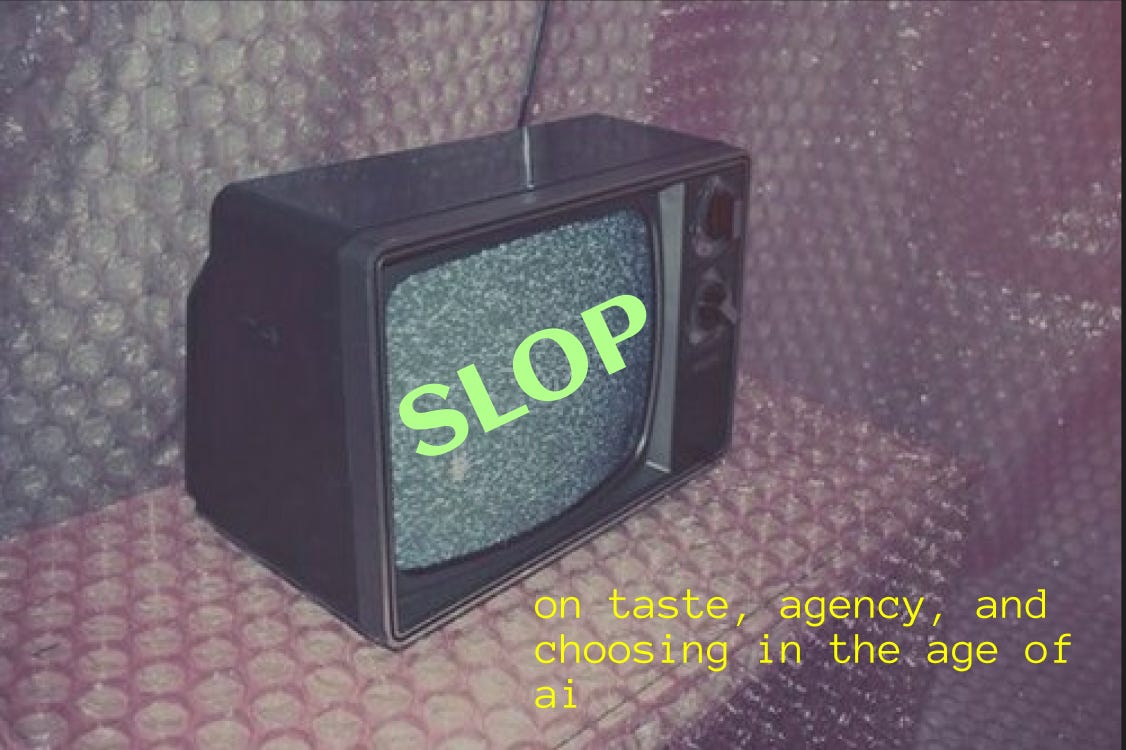
Building for the user has now turned into building for the feed. Startups now spend hundreds of thousands of dollars to produce media in the hopes of capturing a sliver of consumer mindshare. For you pages tug us eight videos deep into “Who TF did I marry” series, the latest rage bait on X now seeds our conversations, or we ask a model how to raise a newborn instead of calling our mom.
We lose our capabilities in these small, almost invisible moments, when we stop making decisions, stop reaching out, and default to whatever’s right in front of us. We immerse ourselves in hyper-personalized feeds that seem to know us better than ourselves. We’re in danger of not just outsourcing tasks, but our thinking itself, to increasingly capable models.
As a result, our taste slowly erodes, our muscle to choose for ourselves weakens, and over time, our over-reliance on algorithms can impede our ability to connect with people. We slip into slop: passively consuming whatever the algorithms put in front of us.
Sometimes it’s nice not to think or make decisions. But I worry we’re losing our sense of taste when we no longer have recommendations of our own but simply let algorithms define them for us. Becoming a victim of the algorithm is the least agentic thing you could do.
curation and choosing
Models are incredibly powerful tools for accessing information, but they shouldn’t replace the creative journey of discovering, learning, and making sense of the world ourselves.
Our taste and identity are stitched together by the places we frequent, the writing that makes us think, the companions we surround ourselves with, the podcasts and music we listen to, and the books we write chicken-scratch in the margins1. Shared context is often a shortcut to connection - it explains why you instantly click with someone when you realize you listened to the same obscure artist or bookmarked the same article last week. Content seeds conversation.
It’s also why being a good curator is what makes someone instantly cool - someone who “knows exactly what’s worth paying attention to” in a sea of options. Influencers often become known not for creating something entirely new, but for the specificity of their taste: my old roommates would casually say “let’s make Gigi tonight,” alluding to Gigi Hadid’s vodka pasta, or people walk into nail salons asking for “Hailey Bieber glazed donut nails”. And it’s not just online - it shows up in ways from recommending a book that lingers with someone for weeks, putting a friend on a new album that they can’t stop playing on repeat, picking the restaurant for a dinner that everyone loves, or putting your friends on a new trader joes frozen item that ends up being a staple in their meal plan. Curation becomes a kind of social currency: a quiet signal of taste and intention, and good recs often stick with people for life.
It’s important to acknowledge our first encounter with things often could come from algorithms - a style inspo board on pinterest, a rec you see on Tiktok, an insight from a twitter thread. But the things that actually shape your taste are rarely those one or two snippets, it’s how you connect the dots between all of them, how you apply them to your real life, and the rabbitholes you willfully choose to dive into after that initial spark of exposure.
when the algorithm has misaligned incentives
Algorithms are shaping not just what we consume, but also what we create. When the rules of algorithmic feeds are constantly changing - in terms of what they reward, amplify, or bury - it’s easy to lose yourself in the process. Your creative agency narrows to whatever fits inside the algorithm’s reward system, subconsciously playing into a status game you never opted into.
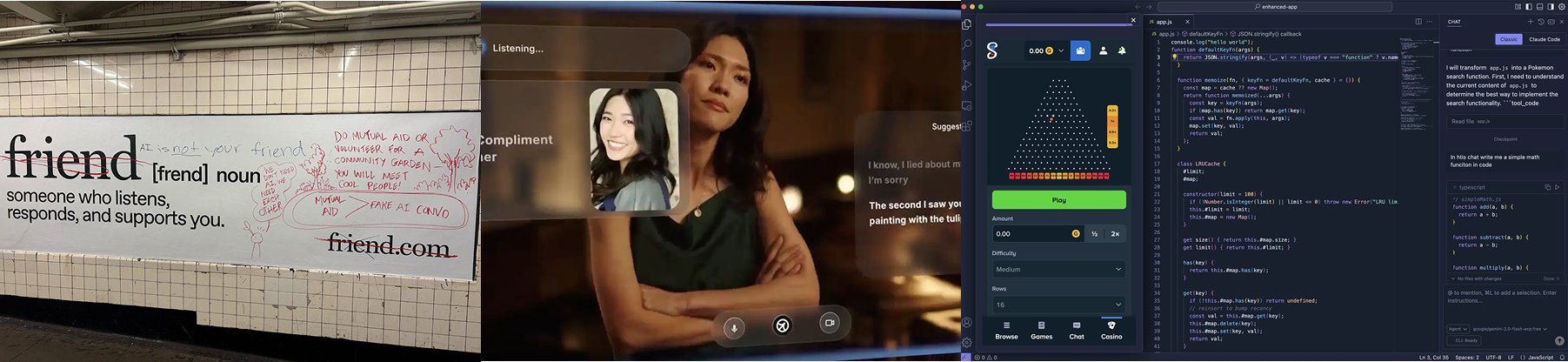
Algorithms incentivize extremes: hot takes, thirst traps, rage bait, shit posts, or compressing a blog post into two algorithm-friendly sentences because that’s what performs. “Cheat on everything” will always outperform an “AI meeting notetaker” because of its sheer shock value.
You see this play out in real time, most recently when discourse about a comment poking fun at a hackathon photo dominated an entire day’s feed. Suddenly everyone rushes to add their own commentary, quote tweet, or reaction to stay visible and ride the same wave of attention.
And you see this dynamic also follows startup culture, too. The feed rewards hype, narrative, and performative culture, and often overlooks the slow, unglamorous progress of solving hard problems. It’s why launch videos are everywhere now - often pre-product, sometimes overstating the real capabilities of what’s being built. You might see those same founders “quiet quit” or pivot to the next shiny thing not too long after.
As someone who’s chronically online, one of the hardest lessons I’ve learned is that chasing virality is another form of slop. Attention and eyeballs are gratifying, but they’re fleeting and do not last long. Sharing online is valuable - it sparks conversation, inspiration, and helps refine ideas. But if you look back on your year and your proudest output is a handful of viral tweets, it doesn’t mean much unless it was a by-product of a deeper pursuit where you uncovered something meaningful.
It’s easy to feel disheartened when a piece of work you’ve spent months iterating on doesn’t see the light of day on the feed. Algorithms are finicky, constantly changing, and very much out of our control. Views are slop metrics. I’ve found it’s better to focus on the ones that don’t actually scale: the text from someone you haven’t spoken to in years that reached out because something you wrote resonated, the new essay you now have in your back pocket that you can share when reaching out to a mentor you really admire, or simply the satisfaction of finally putting your thoughts into words. Once you understand how the incentives work - what they reward, and what they ignore - it becomes easier to stop letting the algorithm become your editor.
power in the people
Ironically, while writing this very essay, I started by drafting my ideas and iterating on them with AI. Pre-AI frenzy, I would’ve brought early drafts to a weekly writing group or spammed a few friends with a special google doc link. Now with AI being able to catch all my grammar mistakes and craft beautiful sentences, it felt easy to keep the process contained. Why bother other people when an LLM could edit my work instantly?
But the thing I enjoy most about the writing process is the conversations it sparks with people. AI is an incredibly helpful collaborator, but it often behaves like a “yes-man” - it rarely tells you that you’re wrong or pushes back on your ideas unless you explicitly prompt it to. When I finally shared a draft of my work with real people, the direction of it completely changed. They surfaced ideas I hadn’t even thought of and brought perspectives shaped by their unique lived experiences, which would be hard to replicate with a model.
There’s also something special about the knowledge that sits within the margins. Traditions or ways of doing things that aren’t widely documented, but passed down through conversation (you just had to be there!). Like the annotated potions book in Harry Potter and the Half Blood Prince, or my mom’s specific way of making chicken curry - different from any recipe I could find online. These are things you don’t stumble upon by prompting or scrolling. You discover them by paying attention, exploring your environment, through conversation and your relationships with other people2. Over time, those experiences and ways of doing things shape your taste.
Slop thrives in isolation. When you create in a vacuum, it’s easy to converge what you already know, leaving little room to expand your worldview. I always thought to work on great ideas that I needed to be completely heads down, but I’ve learned it takes a balance - solitude to focus and think clearly, and people to challenge, inform, and refine those ideas into something meaningful.
moving towards the anti-slop
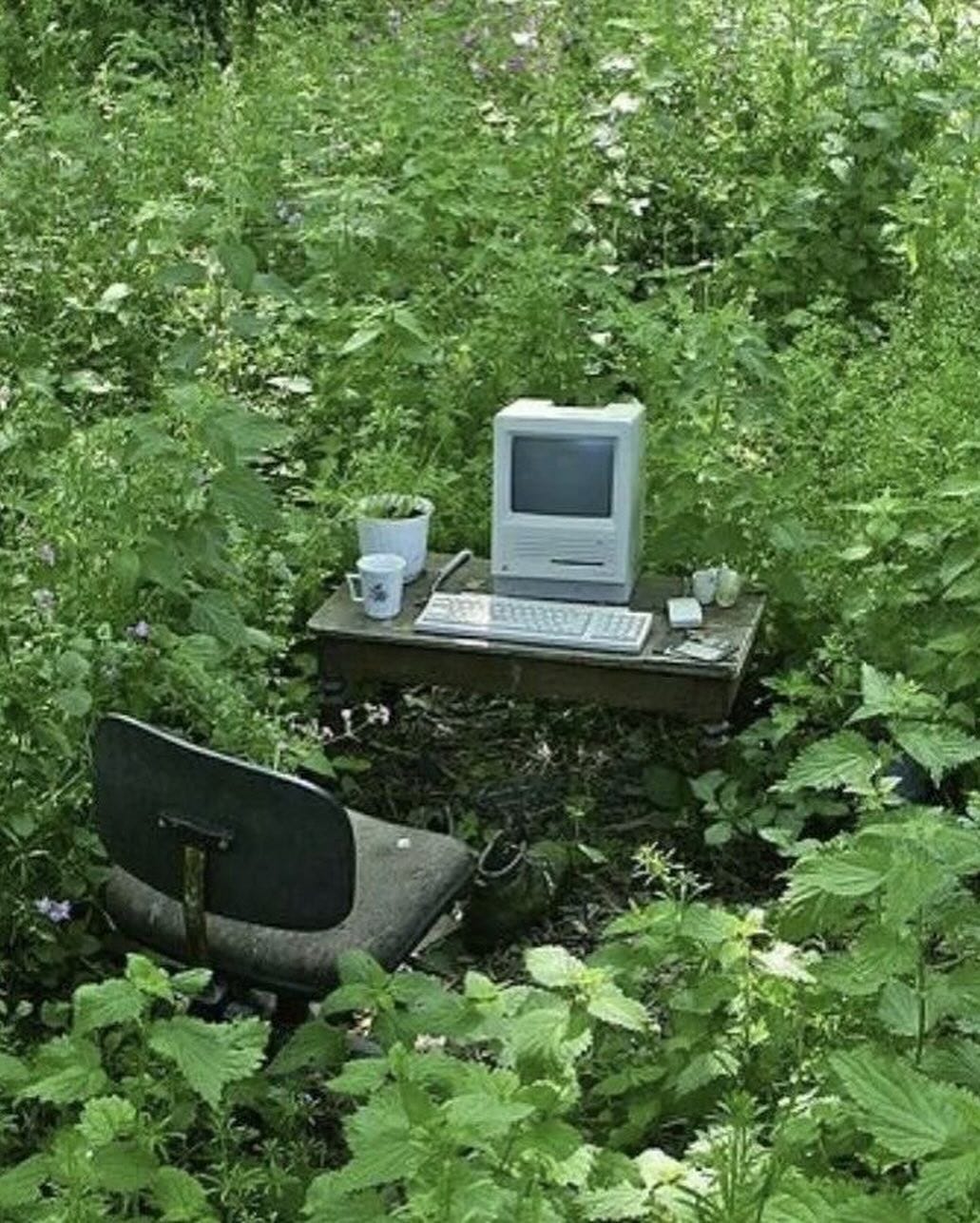
So from time to time, I try to embrace the slowness. Instead of watching a three minute video summary, I want to read the original piece to make sense of it on my own. When writing essays and blog posts, I do a raw brain-dump of my ideas first, even if they’re bad, before I lose my original thoughts to algorithmic edits.
I also try to appreciate the stillness. Instead of jumping to social media to fill an idle pocket of time, what would you look to read, consume, if you had the choice to do so intentionally? Where does your mind wander to when you actually let it be bored?
It’s a privilege to have all the world’s knowledge and every tool available at our fingertips and available to bring our ideas to life. But with all this optionality and abundance, choosing and committing becomes the harder thing. Most people never make the most of the tools available to them - motivation is the bottleneck, not execution.
Slop is easy and passive. What’s harder, and maybe more human, is choosing with intention before the algorithm chooses for us, and deciding what to do with that knowledge once it’s in our hands.
closing words
Thank you so much for giving this a read! I’d love to know if this resonates, sparks any ideas, or if you have a different perspective on this.
I’m also working on a part two, which looks at slop through the lens of design, and why tastemakers, design engineers, and storytellers are becoming increasingly valuable as teams try to build things that actually matter.
Special thanks to Gian, Keshav, Janvi, Jane, Shaahana, Gabby, and Mackenzie for helping shape this piece with their feedback and ideas!
some related musings on this topic
Don’t take the bait, by Jasmine Sun
Aadil on 9 ideas on how culture on social media works in 2025
Jordi Hays on Rage Baiting is for Losers
Naheel on the Dialectic podcast - a will to care
Isabel on my phone is making me dumb
Christine’s list of lists is a great example of stitching together things about you and the content that’s shaped the way you think
this was such an awesome read 🥺